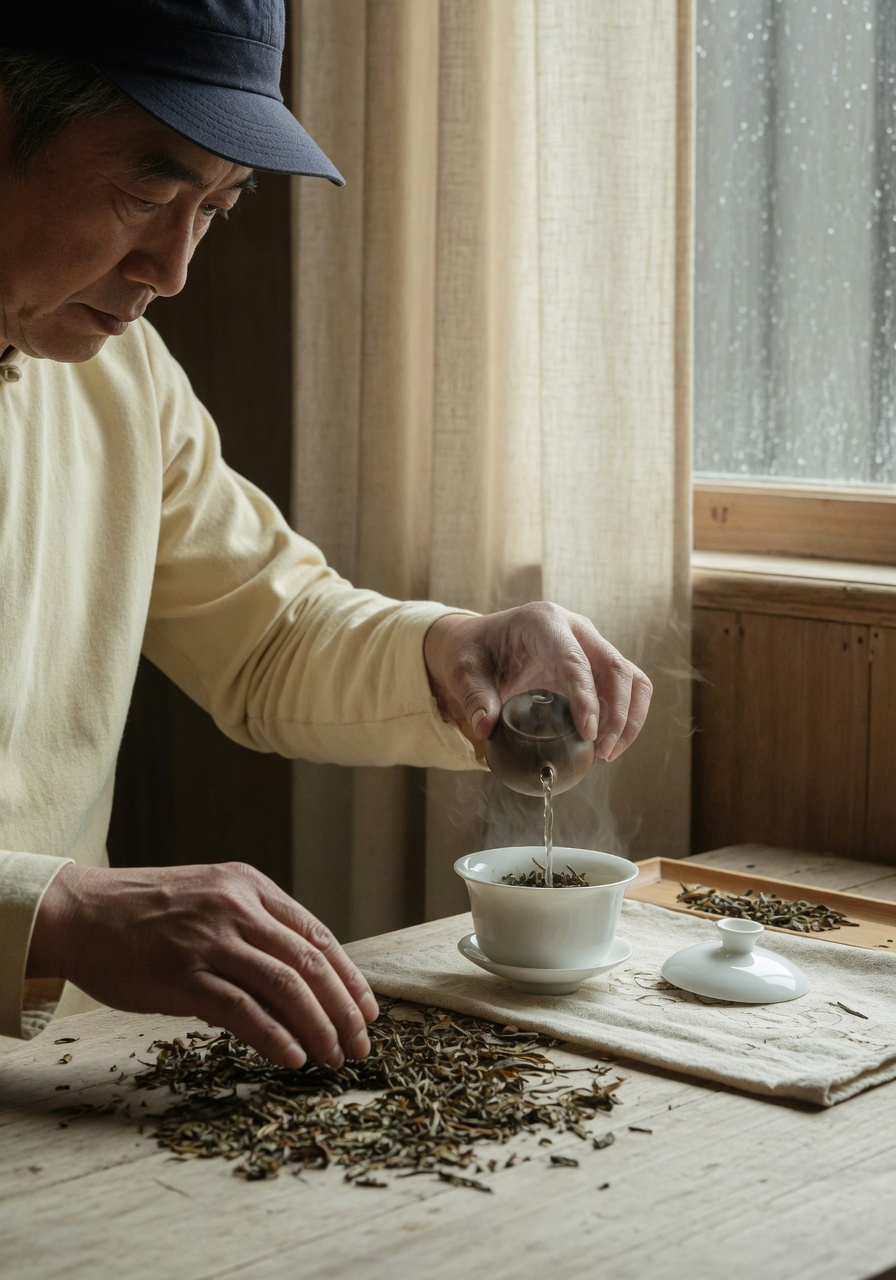
Amgalan Chin came to Chinese tea through the old caravan question — what happens to a pressed cake after it leaves Yunnan and spends a decade in a colder, drier place. He started buying maocha in Kunming in 2011, originally to send north along the same routes his grandparents had used for compressed dark tea, and ended up staying through enough spring seasons to learn the mountains by foot rather than by catalogue.
His work splits the year cleanly. From late February through May he is in Yunnan — Menghai county for the Bulang villages, then east into Mengla for Yiwu, Mahei and Guafengzhai. The rest of the year he is in Ulan-Ude, where he keeps a continental cellar: stable cold winters, dry summers, the kind of slow environment that pulls sheng in a different direction than Guangdong storage. Guests who book the aged sheng pu'er flight taste both sides of that split in one sitting — a Yiwu gushu from a humid Kunming press next to the same producer's cake aged six winters in Buryatia. The wet leaf tells the story before he does: one darker, sweeter, more resolved; the other paler, still woody, still moving.
He trained under two people he names openly. The first is a Bulang producer in Lao Banzhang whose family has been pressing for the village collective since the early 2000s — Amgalan apprenticed three spring seasons there, learning to read maocha by chewing it rather than by sniffing it. The second is a retired Menghai Tea Factory blender he met in Kunming in 2014, who taught him the recipe logic behind the qī zǐ bǐng (七子饼) numbered cakes — why a 7542 from one year drinks like wood and one from another like leather, and how to spot a re-pressed fake by the seam on the nèi fēi (内飞). That second teacher is the reason his shou pu'er flights lean heavily on Menghai and Xiaguan rather than newer boutique pressings.
A private gongfu cha session with Amgalan is quiet and technical. He works on a wide chá pán (茶盘) with a single small kettle, usually two pots in rotation — a thin-walled zhū ní (朱泥) for younger sheng and a thicker zǐ ní (紫泥) for shou or anything older than fifteen years. He weighs leaf rather than eyeballing it, and he will tell you the gram count and the water temperature out loud, because he wants you to be able to repeat the session at home. The first infusion is short, almost a rinse you actually drink — pale gold, faintly bitter, a hint of camphor on the back palate if the tea is from a Bulang source. He stops talking around the fourth steep and lets the tea do the work; most sessions run eight to twelve infusions over roughly ninety minutes.
The aged sheng pu'er flight is his signature catalogue piece. Three to five teas, always one young reference cake (usually a current-year Yiwu or Bulang) so the palate has a baseline, then a middle-aged cake from his Buryatia cellar, then something with real years on it — often a 2005 or 2006 Menghai pressing he has tracked since it left the factory. He will pour the same tea twice from two different pots if you ask, to show how vessel changes mouthfeel; the zhū ní sharpens, the zǐ ní rounds. Infusion colour through an aged Bulang sits somewhere between dark amber and old varnish, and the huí gān (回甘) — the returning sweetness — arrives late, sometimes a full minute after you swallow.
For tea ceremony — host hire for events, Amgalan brings a portable setup that works for groups up to roughly twenty before he recommends bringing in a second master. He prefers gongfu format over chá dào theatre — less performance, more conversation, with the tea moving around the table in small fairness-cup pours so everyone tastes the same infusion at the same time. He has hosted for gallery openings in Moscow, a private dinner in Ulaanbaatar, and a corporate retreat in Kunming; for events larger than thirty he coordinates with Fang Ting for the oolong half of the table.
He reads and writes Mandarin to a working level, speaks Russian and Buryat at home, and English in sessions. He does not romanticise the trade routes — he will tell you, if asked, that most of the historical chá mǎ gǔ dào (茶马古道) stories sold to tourists are stitched together from three different centuries — but he is genuinely useful on the technical question of how dark tea behaved over a six-month caravan, because his family kept the receipts.
Guests who want to go further after a session with him often continue through tea.school for the pu'er track, or follow the producer notes he publishes on puerh.app.
3 sessions run by Amgalan
Book a session
Private gongfu cha session
A 90-minute personal session — usually one Chinese tea explored across 8–12 infusions, gaiwan-led, with the master narrating what's happening between brews.
from €180
Aged sheng pu'er flight
A 90-minute vertical through three to four aged sheng cakes — 5-year, 12-year, 20-year, sometimes earlier — drawn from a continental cellar in Buryatia. The session includes wet-leaf evaluation and a single-cake takeaway sample, a quiet deep dive for those who already love raw pu’er.
from €240
Tea ceremony — host hire for events
A trained tea master attends your private gathering — gallery openings, corporate receptions, weddings — and runs a quiet gongfu station, serving two or three Chinese teas for the duration. All equipment and leaf included. Calm presence, no intrusion, pure tea.
from €520