Chen Hui Yi grew up in Chaozhou, Guangdong, where the fragrance of dāncōng drifted through family kitchens, but their professional path curved toward the quiet elegance of white, green, and yellow teas. Today, as a senior tea expert with Teamotea, they lead the white tea and yellow tea curriculum on tea.school, contribute regularly to tea.community tasting panels, and host private and comparative sessions that reveal how much complexity can live in a seemingly simple white leaf.
Training began formally in 2008, but the pivotal moment arrived in 2016 when they spent three weeks on Taimu Mountain in Fuding. Morning fog wrapped around bushes of Fúdǐng Dà Bái Chá as farmer Lin Zheng-yi explained the exact withering window for Bái Háo Yín Zhēn — moving from outdoor sun-wilting to shaded indoor resting with a timing that only a lifetime of observation could calibrate. That visit marked a shift from academic knowledge to hands-on craft. Chen returned every spring until 2020, building relationships with smallholders who still sun-wither on bamboo mats and who taught them how a single afternoon’s humidity can tilt a Shòu Méi from perfume to grain. They also studied yellow tea processing in Huoshan in 2018, learning mēn huáng — the sealed yellowing step — from Master Zhang, a third-generation producer of Huǒqīng. The quiet, low-oxygen warmth of the yellowing chamber taught them a kind of patience that now informs every pour.
For Chen, white tea is a study in time and texture. A fresh Bái Háo Yín Zhēn from 2023 yields a pale champagne liquor with a silky mouthfeel and a hint of sweet hay; a 2018 Shòu Méi cake pressed in Fuding offers a darker amber infusion, woodsy and round, with the gentle warmth of dried jujube. They keep a library of aged whites, some dating to 2010, to demonstrate how white tea's character evolves — a topic they explore deeply in the online white tea aging cohort on tea.school. Their tasting notes also appear on puerh.app, where they document how white tea cakes change under semi-tropical storage conditions in Guangdong, adding a cross-category reference for puerh collectors curious about aging patterns in low-oxidation leaves.
Green and yellow teas round out their palette. Chen’s selection often includes Lóngjǐng from Shifeng, Bìluóchūn from Dongting, and the lesser-known Ānji Báichá, which is a green tea despite the name. The 2024 Shifeng Lóngjǐng infuses an emerald-tinted liquid with a chestnut sweetness that lands clean. For yellow teas, a Jūnshān Yínzhēn from Hunan yields a liquor the colour of light honey, with a soft umami that differentiates it from its white counterpart. Méngdǐng Huángyá from Sichuan brings a toasted-bread note from the low-heat firing. These gentle teas become the backbone of their private gongfu session, where a guest sits across a small tea table and experiences three white-green-yellow infusions in sequence.
In the private gongfu session, the room is quiet, the gaiwan warm, and Chen’s movements are unhurried. After a first steep of Bái Mǔ Dān, they might ask what you taste — not to test, but to tune the next pour. The format is designed for one to three people, and no two sessions are identical. “The tea leads,” Chen says, “I just hold the kettle.” The session often closes with a gently steamed aged white, its broth deepening over a dozen infusions while the conversation turns to the stories folded into the leaf.
The six-tea comparative tasting expands this encounter into a guided flight. A typical lineup places a 2024 Yunnan moonlight white (Yuè Guāng Bái) beside a 2021 Fuding Shòu Méi cake, a 2023 Bái Háo Yín Zhēn, a 2024 Lóngjǐng, a 2023 Méngdǐng Huángyá, and a 2018 Jūnshān Yínzhēn. Side-by-side, the contrasts become vivid — the silvery fuzz of yinzhen next to the dark, twisted leaves of shou mei, the grassy clarity of longjing against the mellow, brothy yellow bud. Chen draws attention to the way the same hot water coaxes completely different textures from leaves separated only by a few hundred kilometres and a handful of processing choices. The session ends with a guided discussion, often referencing the comparative matrix published on puerh.app for white tea aging markers, which maps sensory shifts across humidity zones.
When hired as a tea ceremony host for events, Chen sets a tea station slightly away from the main noise but visible. Guests drift over, and Chen pours small cups of a welcoming Shòu Méi or a bright Ānji Báichá, explaining a few words about the tea’s origin without overwhelming. The rhythm creates a calm pocket within a dinner party, a wedding reception, or a corporate gathering. For weddings, they may coordinate with the couple to serve the same tea drunk at their first meeting, if known, turning a practical offering into a quiet narrative thread.
The online tasting with shipped sample kit began during the pandemic and now regularly connects tea lovers from Sydney to Stockholm. The kit arrives with 20-gram samples of four teas chosen by Chen, along with a booklet and a link to a live, one-hour video call. Past kits have included a flight of aged whites — a 2016, 2019, 2022, and 2024 Shòu Méi — or a yellow tea trilogy of Jūnshān Yínzhēn, Huǒqīng, and Méngdǐng Huángyá. Participants brew along at home, and Chen comments on the liquor’s colour, the changing aromas, and the mouthfeel, turning a kitchen counter into a shared tasting room.
Community reaches beyond the cup. Chen hosts a monthly “White Leaf Wednesday” discussion on tea.community, where members compare steeping parameters for Bái Mǔ Dān across different years and terroirs. Their monthly column on puerh.app — “The Light Leaf Cellar” — tracks the aging trajectory of a single 2018 Shòu Méi cake stored in Guangzhou against one kept in a drier northern cabinet. They also occasionally advise tea.travel itineraries in Chaozhou, leading visitors to the Fenghuang mountains for dāncōng context without steering them away from the white tea path.
In a small studio in Guangzhou, a humidity-controlled cabinet holds dozens of white tea cakes, each tagged with origin and pressing year. When not teaching or pouring, Chen can be found there, cupping a 2012 Bái Háo Yín Zhēn to check its evolution. It is a quiet practice — one that underpins the knowledge they bring to every session, from a quick online kit to a long evening of comparative tasting.
4 sessions run by Chen
Book a session
Private gongfu cha session
A 90-minute personal session — usually one Chinese tea explored across 8–12 infusions, gaiwan-led, with the master narrating what's happening between brews.
from €180
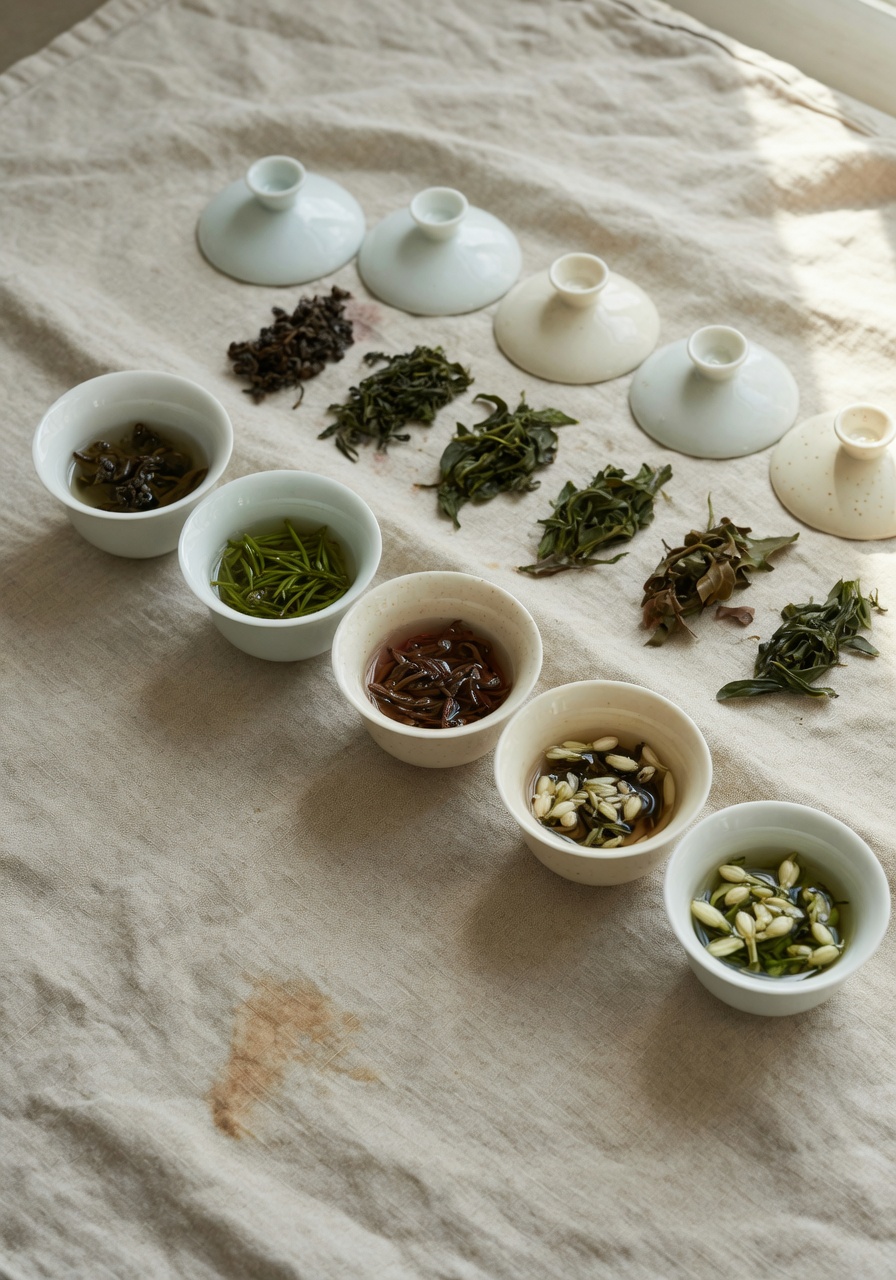
تذوق مقارن لأنواع الشاي الستة
ست فئات — الأخضر، الأبيض، الأصفر، الأولونغ، الأسود، الداكن — تُحضَّر جنبًا إلى جنب في أوانٍ متطابقة، بماء متطابق، ووقت متطابق. ساعتان من المعايرة المنظّمة مع اثنين من المتذوقين الخبراء.
from from €90 per guest
Tea ceremony — host hire for events
A trained tea master attends your private gathering — gallery openings, corporate receptions, weddings — and runs a quiet gongfu station, serving two or three Chinese teas for the duration. All equipment and leaf included. Calm presence, no intrusion, pure tea.
from €520
Online tasting with shipped sample kit
We ship a curated tea kit to you — six teas, a small gaiwan, brewing notes — and then meet over video for a guided 90‑minute exploration of Chinese tea traditions, wherever you are.
from €120 per kit + session fee